What is Silver Dapple Dilution or 'Z' Gene?
The horse Silver dilution gene dilutes black pigment but has no effect on red pigment. The mane and tail are lightened to flaxen or silver gray, and may darken on some horses as they age. A solid black horse with this gene will be chocolate colored with a lightened mane and tail. A bay horse will have the black pigment on the lower legs, mane and tail lightened. Sometimes bay horses with Silver dilution can be mistaken for chestnuts with a flaxen mane and tail. Silver dilution is inherited as a dominant trait. It is known to occur in Rocky Mountain horses and related breeds, Shetland ponies, Icelandic and Morgan horses.
The gene responsible for Silver dilution has been recently identified as PMEL17 by researchers in Sweden. Two single nucleotide substitutions have been found to be associated with the dilution, one in intron 9 -- A (normal) to T (silver) -- and the other in exon 11 -- C (normal) to T (silver). VGL's test for Silver dilution assays both sites.
Silver Dilution test results are reported as:
N/N - No evidence of altered sequence detected.
N/Z - One copy of the altered sequence detected. Black-based horses will be chocolate with flaxen mane and tail. Bay-based horses will have pigment on lower legs lightened and flaxen mane and tail. No effect on chestnut color.
Silver Dilution test results are reported as:
N/N - No evidence of altered sequence detected.
N/Z - One copy of the altered sequence detected. Black-based horses will be chocolate with flaxen mane and tail. Bay-based horses will have pigment on lower legs lightened and flaxen mane and tail. No effect on chestnut color.
Z/Z - Two copies of altered sequence detected. Black-based horses will be chocolate with flaxen mane and tail. Bay-based horses will have pigment on lower legs lightened and flaxen mane and tail. No effect on chestnut color.
Reference: Brunberg E, Andersson L, Cothran G, Sandberg K, Mikko S and Lindgren G. 2006. A missense mutation in PMEL17 is associated with the Silver coat color in the horse. BMC Genetics 7:46. From U.C. Davis Veterinary Genetic Lab
Reference: Brunberg E, Andersson L, Cothran G, Sandberg K, Mikko S and Lindgren G. 2006. A missense mutation in PMEL17 is associated with the Silver coat color in the horse. BMC Genetics 7:46. From U.C. Davis Veterinary Genetic Lab
Coat Color
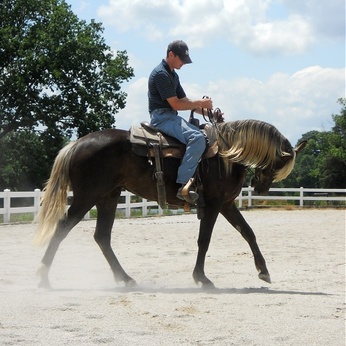
Montana - Black Silver QH/Draft - Photo courtesy of Silver Moon Stables
Black SilverE? aa Z?
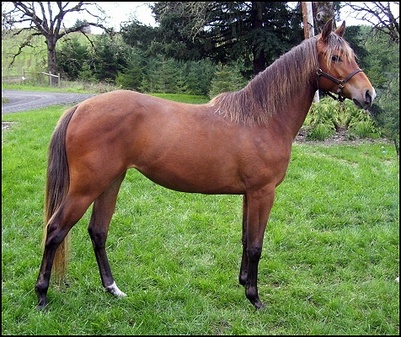
Khepri - Bay Silver ApHC Mare
Bay SilverE? A? Z?
|
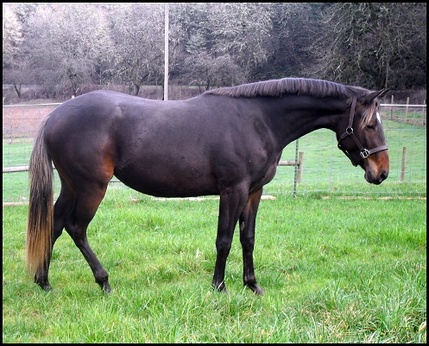
Safyre - Brown Silver AQHA Appendix Mare
Brown SilverE? At? Z?
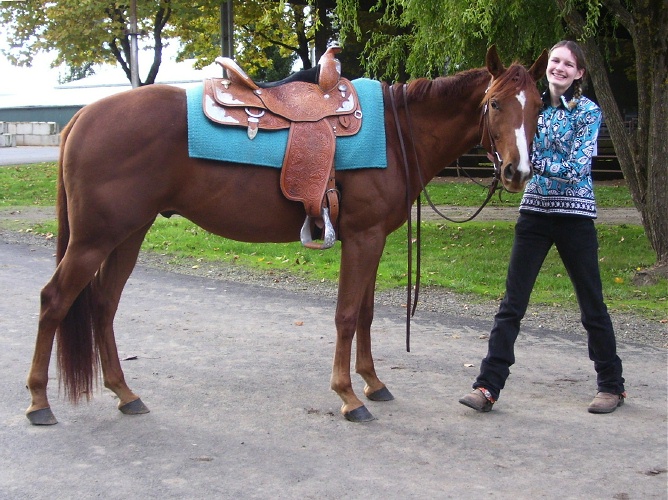
Leonti - Chestnut 'Silver Carrier' AQHA Appendix Gelding - Silver is not known to express itself on chestnut or red-based horses
Chestnut & Silveree ?? Z?
|
Characteristics
- Manes, Tails & Forelocks - diluted from black to flaxen/white to self colored (body color)
- Legs - legs will have a webbing pattern and the black will be diluted to a silvery mushroom color
- Eyelashes - sometimes when a silver foal is born they will have white eyelashes
- Dapples - it is thought that silver creates or accentuates dapples. However, good nutrition is also thought to create dapples.
- Hooves - some silvers have striped, wedgy hooves
To see photo or learn more about silver dapple dilution got to: www.SilverEquine.com